
Accountability
Media Concealment or Strategic Calm?
Quis autem vel eum iure reprehenderit qui in ea voluptate velit esse quam nihil molestiae consequatur, vel illum qui dolorem.


Media Concealment or Strategic Calm? The Lapse of Bokani Soko in Fertilizer Scandal Coverage
In a nation grappling with corruption and economic mismanagement, transparency from both state institutions and the media becomes not just important, but absolutely essential. Recently, a growing wave of public frustration has emerged over the apparent editorial manipulation by News Diggers (ND), one of Zambia’s most prominent newspapers. Their decision to downplay, or completely omit, the name of Bokani Soko—an individual explicitly mentioned in an Anti-Corruption Commission (ACC) press release—has stirred public outrage and raised serious questions about media independence and integrity.
The scandal in question involves $131 million USD worth of undelivered fertilizer under a contract facilitated by the Ministry of Agriculture. While the ACC statement named multiple officials, including Bokani Soko, News Diggers chose to center its headline and imagery around Honeybee Pharmacy’s $17 million health kit scandal instead. This editorial decision, whether by error or intention, reflects what many believe is a troubling trend of selective coverage designed to protect the powerful.
A Breakdown of the Allegations: The ACC’s press release on the matter was unambiguous. It named former Agriculture Permanent Secretary Songowayo Zyambo and Neria Investments Limited Director Bokani Soko, among several others. The release stated that the government had paid out over $131 million USD to Neria Investments for fertilizer that was never fully delivered.
The contract—MOA/FISP/G/1/2020—stipulated the delivery of more than 135,000 metric tonnes of D-Compound and Urea. However, audits and investigations have revealed that substantial portions of these orders were never fulfilled, even though payment was made in full.
The fraud was allegedly facilitated through a letter signed by Zyambo confirming 100% delivery to Zambia National Commercial Bank. This confirmation triggered the release of funds. However, testimonies, logistical audits, and internal whistleblower reports have since contradicted this claim. The implication is severe: public funds were funneled into a private company under fraudulent pretenses.
The Bokani Soko Silence: The controversy begins not with the ACC report, but with its media reception. While the full ACC press release circulated widely and included Bokani Soko’s name early in the statement (words 22 and 23 in the first paragraph), News Diggers’ coverage chose to highlight the Honeybee scandal instead.
Their front-page story featured Honeybee directors and their case involving forged documents and partial delivery of health kits worth $17 million USD. This case, while serious, is significantly smaller in scale compared to the fertilizer scandal, which involves nearly eight times the financial loss.
Critics argue that the editorial decision to lead with the Honeybee story was more than just a judgment call—it was a strategic omission. By sidestepping Bokani Soko’s role, ND failed to fully inform the public about one of the key figures in a major corruption case.
Legal, Political, and Media Influence: Understanding why Bokani Soko may be protected requires examining his network. As a partner at Ferd Jere and Company, he is not only a lawyer but also a long-time legal representative of high-ranking political figures.
He served as counsel for Prime TV in its defamation case against Gerald Shawa and for Edith Nawakwi in the controversial Kalomo farm case involving Hakainde Hichilema. These connections link him to both media influence and political power.
Moreover, Bokani Soko is alleged to have ownership or a stake in Diamond TV, further intertwining him with Zambia’s media landscape. If one media house is owned by an individual under investigation and another deliberately omits that individual’s name from major coverage, public concern is justified.
Transparency and accountability are undermined when the lines between media, law, and politics are blurred by personal or financial interests.
Double Standards and Media Ethics: The role of the press is not just to inform but to protect the public interest. When powerful individuals are involved, this responsibility becomes even more critical.
By leading with a smaller corruption case while downplaying a larger one, ND may have unintentionally distorted public discourse. This can create a false narrative that misplaces public outrage, diverts accountability, and shields those responsible.
Public confidence in journalism is rooted in fairness and consistency. If certain names are systematically avoided or protected, journalism becomes compromised. Such actions erode trust not only in the media but also in the justice system and democracy itself.
Implications for Zambia’s Democracy: This issue extends beyond one individual or one company. It reflects deeper institutional vulnerabilities within Zambia.
With corruption draining national resources and systems appearing to protect those responsible, the space for justice continues to shrink. If media houses that once stood for transparency begin prioritizing alliances, the path toward reform becomes increasingly difficult.
Furthermore, Zambia’s international reputation is at stake. Scandals such as the Honeybee case and the fertilizer fraud influence how global investors, donors, and development partners view the country. Instead of seeing a growing democracy, they may perceive a system in decline—where financial influence outweighs truth.
Who Will Tell the Full Story?
Bokani Soko remains a central figure in what could be one of Zambia’s largest post-independence corruption scandals. Yet, while the ACC names him, parts of the media appear to minimize his role.
It is now up to responsible journalists, civic institutions, and the public to demand full transparency. The press must tell the complete story—without fear or favor.
Otherwise, the nation risks entering an era where wrongdoing is not only ignored but normalized, protected, and sustained.
In-Depth Investigative Feature – August 2025


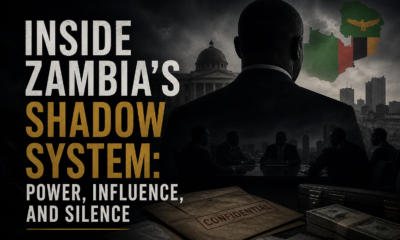






EXCLUSIVE INVESTIGATIVE FEATURE | 2025
“The Shadow Syndicate” presents serious allegations surrounding alleged offshore wealth, luxury Dubai assets, online gaming operations, shell companies, and suspected corruption networks linked to individuals named in the publication. The report raises questions about financial transparency, abuse of influence, and the movement of funds across international jurisdictions.
According to the claims made in the publication, a luxury villa in Dubai Hills Estate reportedly valued at over $20 million USD is alleged to be connected to hidden beneficiaries through offshore arrangements and shell entities. The report further alleges that online gaming and financial operations based in Zambia may have facilitated suspicious transactions and cross-border financial activity.
The publication also discusses allegations of political protection, legal shielding, and financial influence allegedly used to avoid scrutiny and delay investigations. It claims that while ordinary citizens face economic hardship, inflation, shortages, unemployment, and collapsing public services, powerful networks continue to operate with impunity.
Additional concerns raised include:
 Alleged money laundering networks Offshore accounts and shell companies Illegal online gaming operations Unexplained luxury assets Weak enforcement and stalled investigations Political influence and institutional silence International movement of funds and assets
The publication calls for:
Independent investigations Asset tracing and recovery Financial transparency International cooperation Anti-corruption enforcement Extradition where necessary Protection for whistleblowers and journalists Justice without fear or political interferenceAll accusations mentioned remain allegations unless proven in a court of law or confirmed by official investigative authorities. Every individual named is entitled to due legal process and the presumption of innocence.#JusticeForZambia


-

 Accountability9 years ago
THE EMPIRE BEHIND CLOSED DOORS
-

 Accountability9 years ago
Bokani Soko is known as a Zambian lawyer (barrister)
-

 Accountability9 years ago
DIFFIKOTI IS FUNDED BY BOKANI SOKO
-

 Accountability9 years ago
CREATE CHAMPIONS IN MILLY BEAUTY, BOKANI SOKO & OTHERS
-
 Accountability9 years ago
PAIPA PANO – GILBERT PHIRI IS AT ACC FASTEN YOUR SEATBELTS – BOKANI SOKO, HONEYBEE, ZUNEID AND OTHERS CAUTIONED
-

 Accountability9 years ago
Zambia Police questioning Bokani Soko – Zambia
-

 Accountability9 years ago
IS CHITIMUKULU, WITH ALL HIS ALLERGED EDUCATION, HAPPY OVER WHAT IS HAPPENING TO REMAINS OF EDGAR LUNGU?
-

 Accountability9 years ago
Notable UAE Corruption / Financial Crime Cases